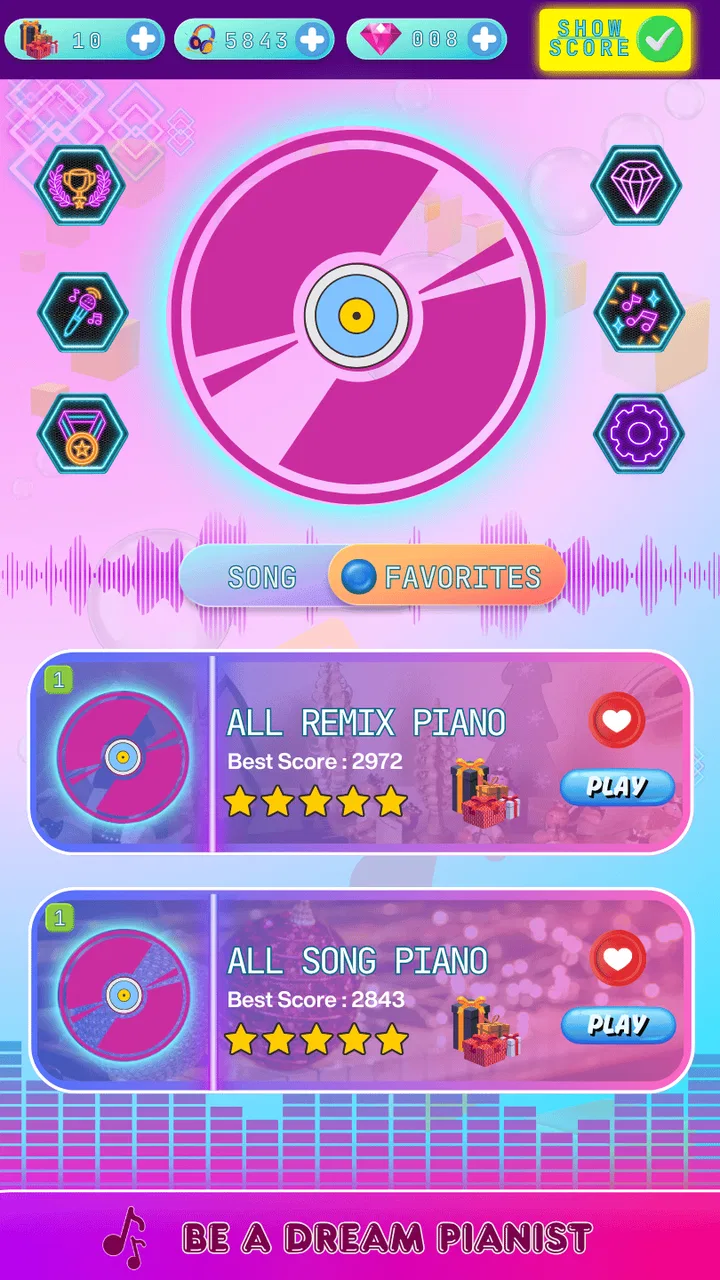
All Song Michael Jackson Piano
- 3.8
- Rating
- 100.00K
- Installs
- Free
- Price

 Analysis by App-foxy
Playing All Song Michael Jackson Piano gave me a very focused first impression: this is a music game built around the appeal of piano play and Michael Jackson’s songs, rather than a broad rhythm package with many unrelated modes. The idea is easy to understand, and that simplicity is part of its charm. I can open it when I want a quick musical distraction, choose a familiar song, and concentrate on timing instead of learning a complicated interface.
The game comes from Sgpt Tech and is free to use. It is listed for Everyone, which makes the concept approachable for younger players as well as adults who simply enjoy tapping along to recognizable music. Its store summary presents it as a way to support the dream of becoming a pianist, but I would describe it more carefully: it offers a playful introduction to piano-style interaction, not a replacement for lessons or a real keyboard.
That distinction matters. If you expect a complete piano simulator, sheet music, or a structured music-learning course, this is probably not the right destination. If you want a lightweight game that turns Michael Jackson’s musical identity into a simple rhythm challenge, it is easier to appreciate. I found the strongest part of the experience in that immediate connection between a well-known artist and a familiar game action.
You May Also Like

 AccuWeather: Weather Radar
AccuWeather Review: A Quick, Clear Forecast for Everyday Decisions
For everyday plans, the best forecast is the one you can understand quickly. AccuWeather makes rain timing, radar, and local conditions easy to act on, with a few trade-offs.

 Hill Climb Racing
Why Hill Climb Racing Still Turns Crashes Into One More Run
A tiny car, a bumpy hill and one more upgrade: Hill Climb Racing keeps resurfacing because its simple chaos makes every near-miss feel personal.

 AliExpress - Shopping App
AliExpress Makes Global Shopping Feel Personal, but Shoppers Bear the Risk
AliExpress turns a global marketplace into a pocket-sized discovery engine. Its reach is useful, its shopping loop compelling, and its trade-offs easy to miss.

 Lords Mobile: Kingdom Wars
Lords Mobile Is a Kingdom-Building Routine, Not a Quick Match
A case-by-case verdict on the building, battles, device demands, and social commitments that make Lords Mobile rewarding for some players and exhausting for others.

 PDF Scanner app - TapScanner
TapScanner Makes Paperwork Easier to Capture, Check, and Share
TapScanner makes scanning with a phone feel less like a rescue operation and more like a dependable step in getting work done. Its capture tools are useful, though not flawless.

 Block Blast!
 Shows How Much a Puzzle Game Can Leave Out
A quiet grid game shows why puzzle players increasingly value instant clarity, repeatable skill and low-pressure play—and where the genre still needs to catch up.
More From Our News Desk
View All News


How the artistic idea shapes the playable experience
I see the artistic idea as the game’s organizing principle: Michael Jackson’s music supplies the identity, while the piano-style interaction gives me a direct way to respond to it. That focus makes the experience easy to approach, but it also means the enjoyment depends on whether this particular musical world feels inviting to you. From there, it’s worth looking at how that idea translates into a practical session.
A quick entry point for casual players
The game’s appeal is strongest when I treat it as a short-session activity. There is no need to prepare an instrument, understand music notation, or spend a long time customizing a profile before playing. That makes it suitable for a spare moment during a commute, a quiet break, or an evening when I want something more active than simply listening to music.
In an everyday scenario, I could hand the phone to someone who enjoys Michael Jackson but does not normally play games. The musical theme gives that person an immediate reason to try it, while the piano format explains what to do without a long tutorial. A child can approach it as a tapping game, while an older fan may enjoy recognizing the songs and trying to keep a steady rhythm.
My advice is to begin with a relaxed mindset. The experience works better when I focus on keeping time and reacting to the notes than when I approach it as a serious test of piano ability. That small change in expectation makes the game feel more rewarding and avoids the disappointment of expecting genuine instrument training from a mobile music title.
The visual language stays close to the theme
The central artistic choice is clear: the piano interface acts as the bridge between the performer’s music and the player’s actions. Instead of asking me to explore a large fictional world, the game creates its identity through the combination of a famous musical catalog, piano imagery, and a rhythm-oriented layout. That narrow focus gives the experience a coherent mood even when the actual interaction remains simple.
I like this approach because the setting does not compete with the songs. A more elaborate game might add characters, story scenes, or decorative environments, but those elements could distract from the reason most people would install this title in the first place. Here, the recognizable artist and the piano concept do most of the expressive work.
There is also a trade-off. Players who need a strong narrative setting, detailed animation, or a sense of progression beyond song performance may find the presentation limited. The atmosphere is created through musical association and focused interaction, not through a large world that changes around the player.
Why the mood depends on the player’s expectations
Michael Jackson’s music carries a strong performance identity, so the game benefits from the feeling that each tap is part of a larger musical moment. Even a basic piano game can feel lively when the player recognizes the song and anticipates the next beat. That recognition gives the experience more personality than an anonymous collection of notes would have.
At the same time, the mood can become less convincing if I play only to chase perfect reactions. Rhythm games naturally create pressure, and repeated mistakes can turn a musical session into a mechanical exercise. I found it more enjoyable to alternate between focused attempts and casual play, rather than treating every song as a score competition.
The best way to enjoy this game is to balance musical recognition with relaxed timing. That sounds simple, but it changes how the whole app feels. The songs provide the emotional hook; the tapping provides the challenge; the player’s attitude determines whether the result feels expressive or merely repetitive.
Sound is the main reason to stay
For this particular game, sound is not a background detail. It is the feature that gives the piano interaction meaning. Without the connection to Michael Jackson’s music, the same basic action would feel much more interchangeable with other tapping games. The recognizable repertoire gives each session a stronger sense of occasion and helps the pacing feel tied to something familiar.
I would not approach it as a high-fidelity music-production tool. The game’s purpose is to make listening interactive, not to reproduce the full experience of performing on a real piano. That means the sound should be judged by how well it supports timing, recognition, and momentum rather than by whether it offers the depth of a professional instrument.
One useful habit is to play with the volume at a level where the rhythm remains clear but the taps do not become tiring. On a phone speaker, the balance may feel different from headphones, and the physical sound of tapping can compete with the musical cues. If I am trying to improve my timing, I pay more attention to the audio than to the visual decoration.
Rhythm works best when I listen before reacting
A common mistake in piano-style mobile games is to stare only at the screen and react to visual movement. That can work for a while, but it makes the experience feel frantic. With this title, I get more enjoyment when I let the music establish the pulse first and use the screen as confirmation. This approach also makes the game feel more connected to the artist’s songs instead of turning them into a stream of unrelated taps.
For beginners, I recommend starting slowly and concentrating on consistency. Accuracy is more useful than rushing, especially when a familiar melody encourages me to anticipate notes too aggressively. For experienced rhythm-game players, the challenge may come less from learning the controls and more from maintaining attention through repeated sections.
This is one of the game’s less obvious strengths: the music can make me think I know exactly what comes next, but the playable timing still requires attention. Familiarity helps with confidence, yet it can also create careless taps. Listening closely prevents the songs from becoming background noise.
Simple mechanics, clear purpose
The mechanical fit is straightforward. A piano-themed interface naturally supports tapping, and tapping naturally supports a rhythm game. That alignment is important because the controls do not feel forced onto the subject. I am not pretending to manage a band, build a career, or solve unrelated puzzles; I am interacting with music through a piano-like format.
The simplicity also makes the game accessible. Someone who has never played a rhythm title can understand the basic idea quickly, while a regular mobile gamer can start without adjusting to an elaborate control scheme. The free price lowers the barrier further, especially for people who want to sample the concept before deciding whether it deserves a place on their phone.
However, simple controls can expose limited depth. Once I understand the basic timing, the long-term appeal depends heavily on how much I enjoy the music and how satisfying I find repeated attempts. Players who want complex combo systems, multiple instruments, deep customization, or a long progression structure may prefer a larger rhythm game.
Where it fits among music-game alternatives
Compared with a conventional piano-learning app, this game is more immediately playful and less educational. A learning-focused alternative would be better for reading notes, practicing scales, understanding chords, or building a disciplined routine. This title is better for a quick connection between a favorite performer and a touch-screen challenge.
Compared with a general rhythm game, it has a more specific identity. A broad rhythm title may offer more variety in artists, genres, and modes, while this one concentrates its appeal around Michael Jackson and the piano format. That focus can feel refreshing if I already like the music, but restrictive if I want a constantly changing playlist.
Compared with listening to the songs normally, the game adds participation but removes some of the freedom of passive listening. I cannot simply relax and let every track unfold without interaction. The reward is different: I am paying attention, responding to the beat, and turning familiar music into a small activity.
Who will enjoy it most
I think this game is a good match for Michael Jackson fans who want a casual way to interact with the music, families looking for an accessible music-themed game, and players who prefer short sessions over complicated mobile experiences. It can also suit someone curious about piano games but unwilling to commit to a lesson-based application.
The Everyone age rating supports that broad accessibility, although parents should still decide whether the pace and screen time suit their child. The game is free, so trying it does not require a purchase decision, but free access alone does not guarantee that every player will find enough variety for long-term use.
I would skip it if my main goal were serious piano practice, advanced music theory, or an expansive rhythm-game system. I would also look elsewhere if I did not particularly enjoy Michael Jackson’s music. The focused theme is the reason to choose this app, and it is also the main reason it may not appeal to someone seeking a neutral or genre-diverse music game.
Practical details before installing
The game was released on December 21, 2021, and the current version is 4.1. It requires Android 5.0 or later, so it is suitable for a wide range of older Android phones as well as newer devices. I appreciate that the technical entry point is modest, because a music game should be easy to try without demanding a recent flagship phone.
Its audience is established rather than tiny: it has passed one hundred thousand installs, with a 3.8 average from roughly three hundred fifty-five ratings and ten written reviews. I treat that response as a useful signal, not a guarantee. It suggests that the concept has found interested players, while the middling average also reminds me that a focused music game will not satisfy everyone equally.
Before settling in for a long session, I would check the phone’s touch response and make sure the screen is clean. Piano-style timing can feel unfair when a finger lands near the edge of a small target or when the device is struggling with other tasks. A stable grip also helps: holding the phone too loosely makes quick taps less comfortable and can interrupt the musical flow.
Small habits that improve the experience
My first tip is to use short practice loops instead of immediately trying to play for a long time. A few focused attempts help me learn the timing language without turning the session into a test of endurance. After that, I switch to casual play and let the familiar songs carry the mood.
My second tip is to separate recognition from reaction. Knowing a melody does not mean I should tap ahead of the playable cue. I listen for the actual rhythm, watch the interface, and let those two signals agree before moving. This is especially useful with songs I already know well, because confidence can become overconfidence.
My third tip is to use the game as a gateway rather than a substitute. If a song makes me curious about piano, I can follow the session with a real keyboard or a structured lesson. The game can build interest in rhythm and melody, but it should not be treated as proof that I am learning proper technique. That honest framing gives it a healthy role in a music routine.
How the pacing holds together
The pacing is strongest when the game moves quickly from selection to play and lets the music provide the session’s structure. There is a natural rise and fall: anticipation before the song, concentration during the notes, and a sense of completion afterward. Because the concept is compact, the game does not need a complicated story to create momentum.
The limitation is that this kind of pacing can feel cyclical. If I play for too long, the repeated pattern of choosing a song and tapping through it may lose its freshness. I would use it in bursts rather than expecting it to replace a full evening of entertainment. It is a pocket-sized music activity, not an all-purpose game platform.
My atmosphere verdict
After spending time with it, I see All Song Michael Jackson Piano as a focused, approachable music game whose strongest qualities come from the match between artist, sound, and piano-style interaction. It creates a recognizable mood without needing a large fictional setting, and its controls are easy enough for casual players to understand quickly.
Its limitations are equally clear. The experience may feel too narrow for players who want broad musical variety, and it cannot replace a real piano course for anyone pursuing genuine technique. The long-term value depends on how much the player enjoys returning to Michael Jackson’s songs and refining timing through repeated play.
Still, I would recommend giving it a try if you want a free, accessible rhythm experience built around a specific musical identity. I would describe it to a friend as a small interactive tribute rather than a full piano simulator: best for short sessions, familiar songs, and relaxed concentration. That is a modest goal, but the game’s art direction, sound, and pacing generally support it well.
FAQs for All Song Michael Jackson Piano
01What is All Song Michael Jackson Piano?
All Song Michael Jackson Piano is a mobile app designed for music enthusiasts and fans of Michael Jackson. The app allows users to play piano versions of popular Michael Jackson songs. It's a fun and interactive way to enjoy his music, whether you're a beginner or an experienced pianist.
02Is All Song Michael Jackson Piano free to use?
The app is free to download and offers a variety of songs to play at no cost. However, it may include in-app purchases or ads. Some additional features or songs might require payment, so it's advisable to check within the app for detailed pricing information.
03What are the main features of the app?
All Song Michael Jackson Piano offers a wide range of features, including a user-friendly interface, a variety of Michael Jackson songs to choose from, and multiple difficulty levels. It also includes a practice mode, allowing users to hone their skills before attempting more challenging pieces.
04Can I use the app offline?
Yes, once you have downloaded the necessary content, you can use the app offline. This feature is particularly useful for users who want to practice or play without an internet connection, making it convenient for travel or areas with limited connectivity.
05Is the app suitable for beginners?
Absolutely! The app is designed to cater to all skill levels, including beginners. It features an easy-to-navigate tutorial mode and offers songs with varying difficulty levels. Beginners can start with simpler tunes and gradually work their way up to more complex compositions.
Pros
- Engaging gameplay for music lovers.
- Wide selection of Michael Jackson hits.
- Simple controls for all ages.
- Visually appealing interface.
- Frequent updates with new songs.
Cons
- Limited song variety outside MJ.
- Ads can be intrusive at times.
- Requires internet for full features.
- In-app purchases for premium content.
- Some songs require high skill levels.

All Song Michael Jackson Piano
Gallery